
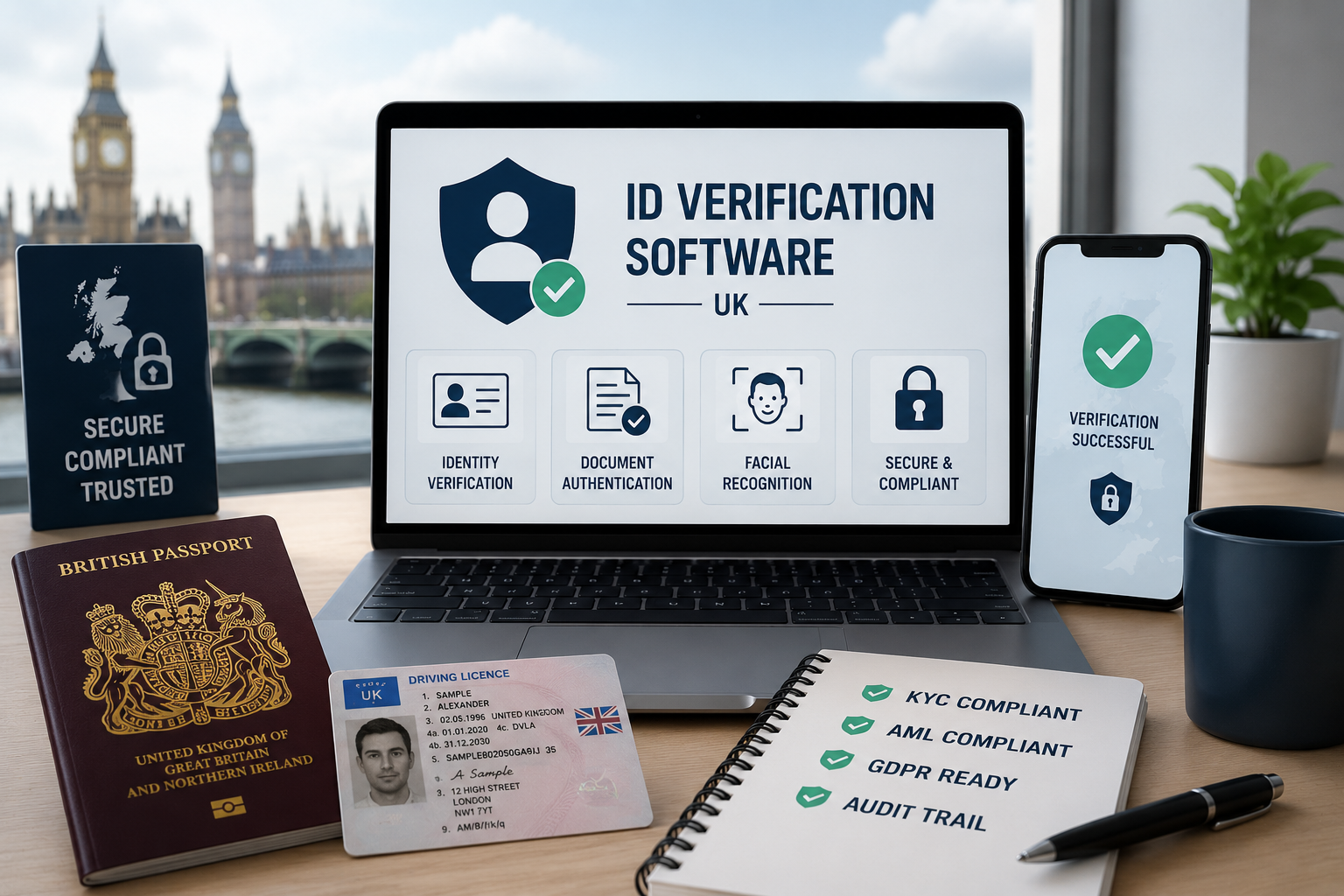

What ID verification software actually does
Modern IDV goes well beyond scanning a document. A typical document-and-biometric flow will:
- Capture the ID document — passport, driving licence, or another accepted credential.
- Authenticate it — check physical and digital security features to detect tampering or forgery.
- Run a biometric match — compare the document photo to a live selfie, with a liveness test to defeat photos, masks and deepfakes.
- Optionally add data and screening — address verification, and sanctions/PEP checks where the use case needs them.
The UK rules that shape your choice
UK identity verification is governed by overlapping frameworks: the Money Laundering Regulations for AML/KYC, and the government’s digital identity trust framework for employment and tenancy checks. The framework — originally the Digital Identity and Attributes Trust Framework (DIATF), now developing into the Digital Verification Services Trust Framework — gained statutory footing under the Data (Use and Access) Act, with digital verification provisions in force from late 2025.
Key takeaway
For Right to Work, Right to Rent and DBS checks, certification under the framework is mandatory, and only providers on the government’s public register qualify. For financial-services AML/KYC, certified providers aren’t strictly required, but certification is formally recognised as meeting due-diligence expectations — so it’s a meaningful differentiator in regulated procurement.
The framework and its certification stages are evolving during 2026. Always confirm a provider’s current certification status on the official government register before relying on it for statutory checks.
What to look for when choosing IDV software
| Criterion | Why it matters | Question to ask |
|---|---|---|
| Certification | Required for Right to Work/Rent/DBS; a quality signal for AML | Are you certified and on the public register? |
| Checks supported | You may need AML/KYC, RTW, RTR, DBS — or all | Which statutory checks does this cover? |
| Biometric & liveness | Defends against forgery and deepfakes | How is liveness tested and fraud detected? |
| Coverage & fairness | A service must work across all groups | How do you avoid discriminatory outcomes? |
| Audit trail | You must evidence what was checked | What record is kept, and is it export-ready? |
| Client experience | Friction costs conversions | Can a client complete it on mobile in minutes? |
| Integration | It must fit your systems | Does it connect to my case-management tool / API? |
Why client experience is a commercial issue, not just a compliance one
A large majority of UK consumers now prefer digital identity services to physical alternatives, and fraud volumes are at record highs — so onboarding friction cuts both ways. Make the flow clunky and you lose clients at the first step; make it weak and you carry fraud and compliance risk. The best IDV software resolves that tension: a fast, mobile-first flow for the client, and rigorous, certified checks underneath for you.
Standalone IDV vs onboarding platform
A pure IDV tool verifies identity and stops there. An onboarding platform wraps identity verification into the whole client-intake process — collecting information and documents, running AML/KYC, PEP and sanctions screening, capturing sector-specific forms, and returning structured data to your systems. If identity is only one part of the problem you’re solving, a platform usually removes more manual work than a verification widget bolted onto your existing forms.
ID verification, built into onboarding — not bolted on
OnBoardNow verifies identity with document capture and a liveness-tested biometric match, then carries the client straight through AML/KYC, PEP and sanctions screening and your sector forms — one flow, full audit trail, structured output to your systems.Book a demo →
Frequently asked questions
Is ID verification software mandatory in the UK?
For Right to Work, Right to Rent and DBS checks done digitally, you must use a provider certified under the government framework and on its public register. For AML/KYC you have options, but certified digital verification is widely used and recognised.
What is IDVT?
Identification Document Validation Technology — the technology used to validate an identity document and confirm it belongs to the person presenting it, underpinning certified digital Right to Work, Right to Rent and DBS checks.
How is IDV different from AML/KYC?
IDV confirms identity. AML/KYC is broader — it adds risk assessment, sanctions and PEP screening and ongoing monitoring. Identity verification is one step inside the wider AML process.
How do I know a provider is certified?
Check the government’s public register of certified providers. Certification stages are being updated during 2026, so verify current status rather than relying on a general claim.
Leave a Reply