
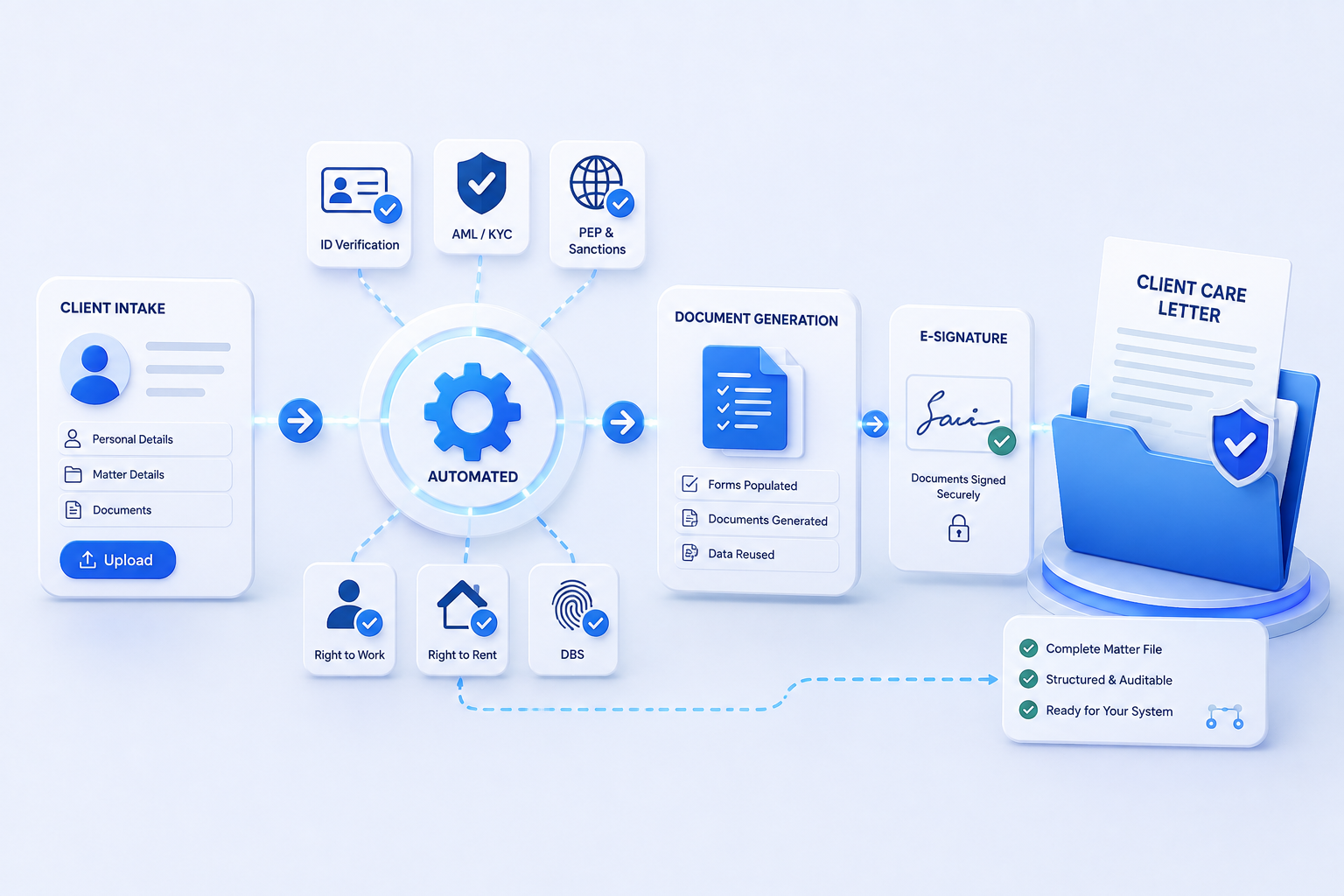

For law firms, matter opening is a whole journey — intake, conflicts, due diligence, engagement documents, signatures and file assembly. AML and ID checks are components within it.
Quick answer
Matter opening is the process of taking a new client instruction and turning it into a live, compliant matter. Done well as a single journey, it collects client and case information, runs conflict and AML/source-of-funds checks, generates the Client Care Letter and any matter-specific forms, captures signatures, and compiles a complete matter file that lands in your case-management system. Identity and AML checks are steps within matter opening — not the whole process.
For most UK law firms, the slowest and riskiest part of taking on work isn’t the legal work itself — it’s everything between “client says yes” and “matter is open and I can start.” That gap is matter opening: client inception, conflict checks, client due diligence, engagement documents and file setup. Run manually, it’s a sequence of handoffs between reception, the fee earner, the conflicts check, and billing — each one a chance to lose time or drop a compliance step.[1]
The firms getting the most value in 2026 treat client due diligence and file opening as one workflow, not two teams passing paper. As one 2026 industry guide put it, the boundary between client due diligence and file opening is dissolving.[2]
Matter opening as a single journey
Instead of a chain of manual steps, matter opening can run as one configured journey:
Capture the instruction & client detailsCollect client and case-specific information through a guided intake, once, from the right person.
Run conflict checksSearch the firm’s matters for conflicts and route anything flagged to the responsible partner.
Client due diligence & AMLcheckVerify identity and run AML/KYC, PEP and sanctions screening where required for the matter.
Source of funds where relevantcheckGather and evidence source-of-funds for conveyancing and other high-risk work.
Generate the Client Care Letter & formsUse the information already collected to produce the engagement documents and matter-specific forms (e.g. TA-series for conveyancing).
Capture signaturesObtain electronic signatures on the engagement documents within the same flow.
Compile & open the matterAssemble a complete, auditable matter file and return it into the case-management system.
The AML and ID checks are steps three and four of seven — essential, but components within matter opening rather than the reason for it. The journey is built around the matter; the checks serve it.
Why this framing matters for law firms
Building matter opening around an AML/ID check leaves the expensive parts — conflicts, engagement documents, forms, file assembly — manual.
Building it as a complete journey captures data once and carries it all the way through to an open matter, with the checks handled inside the flow.
The cost of manual matter opening
50%
reduction in intake time when onboarding/matter opening is automated end-to-end
3.2–4.8 hrs
admin saved per new matter, per Thomson Reuters benchmarking
85%
same-day execution for e-signature engagement letters vs 35% for mailed, per Thomson Reuters
Figures from the cited third-party sources; indicative — verify against the original before quoting.[3]
There’s a compliance dimension too. Under a more assertive SRA, being compliant and being able to demonstrate compliance on demand are different capabilities — and only one of them is a software feature. A single matter-opening journey builds the audit trail as it goes, so the evidence exists the moment it’s asked for.[2]
Multi-party matters
Matter opening often involves more than one person — co-buyers, multiple directors, a guarantor, another adviser. A journey handles this by bringing each party into the relevant step: running checks on each where needed, collecting each signature, and compiling everything into one matter file. The coordination that used to mean chasing several people by email becomes part of the flow.
Key takeaway
Choose matter-opening software by the whole journey it automates — intake, conflicts, due diligence, engagement documents, forms, signatures and file assembly — not by the AML check alone. The check is one step; matter opening is the process.
Automate matter opening as one complete journey
OnBoardNow lets you design matter opening around the matter: collect client and case information, run AML and source-of-funds where required, generate the Client Care Letter and TA forms, capture signatures, and return a complete matter file to your case-management system.Book a demo →
Frequently asked questions
What is matter opening?
The process of turning a new client instruction into a live, compliant matter — covering client inception, conflict checks, client due diligence, engagement documents and file setup.
Is matter opening the same as an AML check?
No. AML and ID checks are steps within matter opening. The full process also covers conflicts, information gathering, Client Care Letter and form generation, signatures and file assembly.
Can a matter-opening journey generate the Client Care Letter and TA forms?
Yes. A complete journey uses the information already collected to populate and generate engagement documents and matter-specific forms, then captures signatures — without re-keying.
How does automated matter opening help with SRA compliance?
It builds an audit trail as the matter opens, so a firm can demonstrate compliance on demand — not just be compliant, but evidence it quickly when challenged.
Does it handle multi-party matters?
Yes. A journey brings each party into the steps that need them — running checks, collecting information and capturing signatures — and compiles everything into one matter file.
Leave a Reply