
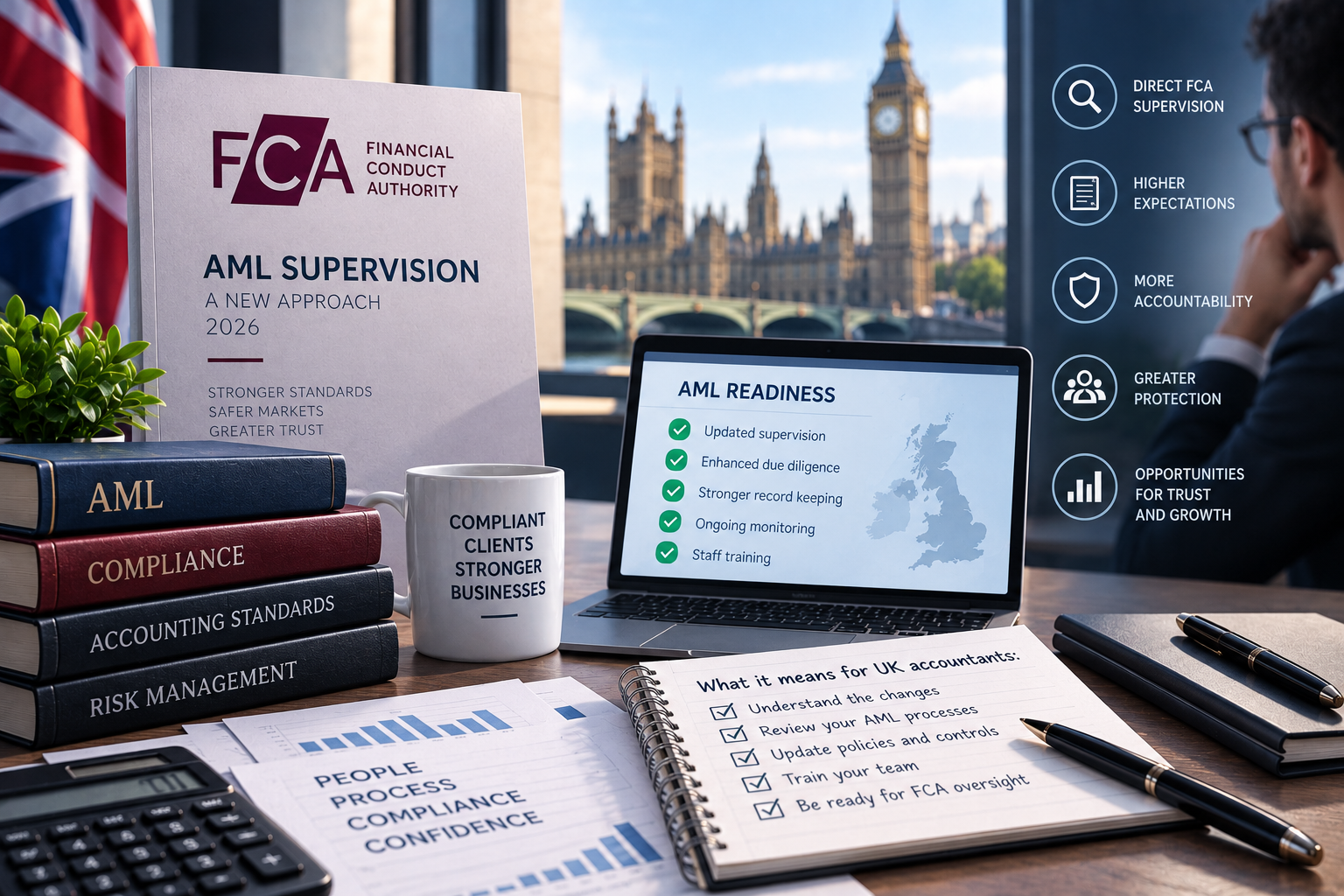

Two big shifts land on accountancy practices in 2026 — FCA AML supervision and the ACSP requirement. Both raise the bar on verifying clients and proving you did.
Quick answer
UK accountants face two big 2026 changes at once: AML supervision is moving from professional bodies like ICAEW to the FCA, and — from spring 2026 — accountants who register clients or file on their behalf need to become an Authorised Corporate Service Provider (ACSP) under the Companies House reforms. Both raise the bar on client due diligence and the ability to evidence it.
For accountancy practices, 2026 is a year of real regulatory change. Two developments in particular reshape how you take on and verify clients — and both point in the same direction: tighter, better-evidenced client due diligence.
Change 1 — AML supervision is moving to the FCA
The government confirmed in October 2025 that the FCA will become the single AML supervisor for professional services, taking over from the roughly two dozen professional-body supervisors — including ICAEW — that currently oversee their members.[1] Around 60,000 businesses (lawyers, accountants and trust & company service providers) are expected to move into FCA supervision.[2] The aim is to end the current fragmentation, where different professional bodies applied rules inconsistently.[3]
Implementation runs over several years, and the professional bodies have raised concerns about cost, duplication and the loss of sector-specific expertise.[4] But the policy is settled, and firms are advised to prepare for a more centralised, data-driven, outcomes-focused regime.
Change 2 — The ACSP requirement (Companies House reform)
Separately, the Economic Crime and Corporate Transparency Act (ECCTA) has given Companies House new powers to verify company directors and persons of significant control. As ICAEW’s economic-crime team has flagged, from spring 2026 accountants who want to register new clients, submit filings or act on their behalf will need to be an Authorised Corporate Service Provider (ACSP) — a regulated agent supervised by a UK AML supervisory body.[5] Becoming an ACSP requires completing identity verification and being registered for AML supervision.
Two changes, one theme: both the FCA transition and the ACSP requirement raise the bar on verifying who your clients are and being able to prove you did it properly. Confirm the exact ACSP timing and requirements with ICAEW / Companies House, as details are still rolling out.
~60,000
businesses moving to FCA AML supervision (incl. accountants)
Spring 2026
ACSP registration needed to file/register clients at Companies House
~26
professional bodies the FCA change consolidates into one
Figures from the cited third-party sources; indicative — verify against ICAEW, Companies House and HM Treasury primary sources before relying on them.
What both changes have in common
Whether it’s the FCA’s data-driven supervision or the ACSP’s identity-verification requirement, the underlying expectation is the same: know your client, verify them properly, and be able to evidence it. As ICAEW’s economic-crime manager put it, for accountants professional scepticism and due diligence remain as important as ever.[5]
Add expert quote before publishing
“For accountants, 2026 isn’t about learning a new rulebook so much as being able to prove you followed the one you already have. Both the FCA transition and the ACSP requirement reward practices whose client onboarding is systematic, verified and evidenced by default.”
— Suggested placeholder for a quote from Osman Ismail (founder input, OnBoardNow / DPS Software). Replace with a real, approved quote, or remove.
How accountancy practices can prepare
- Tighten client due diligence now — consistent identity verification and AML/KYC on every client, every time.
- Sort out ACSP registration — check the spring-2026 requirements with ICAEW/Companies House and complete the necessary identity verification.
- Make compliance demonstrable — keep a complete, retrievable audit trail of checks and decisions for a data-driven supervisor.
- Standardise onboarding — remove the between-staff variation that a centralised regulator will scrutinise.
- Track the transition plan — assign someone to follow the FCA timeline and fee details as they’re published.
Key takeaway
The accountants who’ll navigate 2026 most smoothly are those whose onboarding already verifies clients consistently and produces evidence automatically — so that whether it’s the FCA or an ACSP check, compliance can simply be shown.
Consistent, evidenced client onboarding for accountants
OnBoardNow verifies client identity and runs AML/KYC checks inside one guided onboarding journey, capturing a full audit trail by default — helping your practice meet a rising compliance bar and demonstrate it on demand.Book a demo →
Frequently asked questions
Is AML supervision for accountants really changing?
Yes. The government confirmed the FCA will become the single AML supervisor for professional services, replacing bodies like ICAEW. Implementation is phased over several years, but the policy is settled.
What is an ACSP?
An Authorised Corporate Service Provider — a regulated agent (such as an accountant) supervised by a UK AML body. From spring 2026, accountants who register clients or file on their behalf at Companies House are expected to need ACSP status.
Do these changes increase my compliance workload?
They raise the bar on verifying clients and evidencing it. The core AML obligations remain, but expectations around consistency and demonstrable compliance rise — which is easier to meet with a standardised onboarding process.
When do the changes take effect?
The ACSP requirement is expected from spring 2026; the FCA supervision transition is phased over several years. Confirm exact dates with ICAEW, Companies House and HM Treasury as details are published.
Leave a Reply